
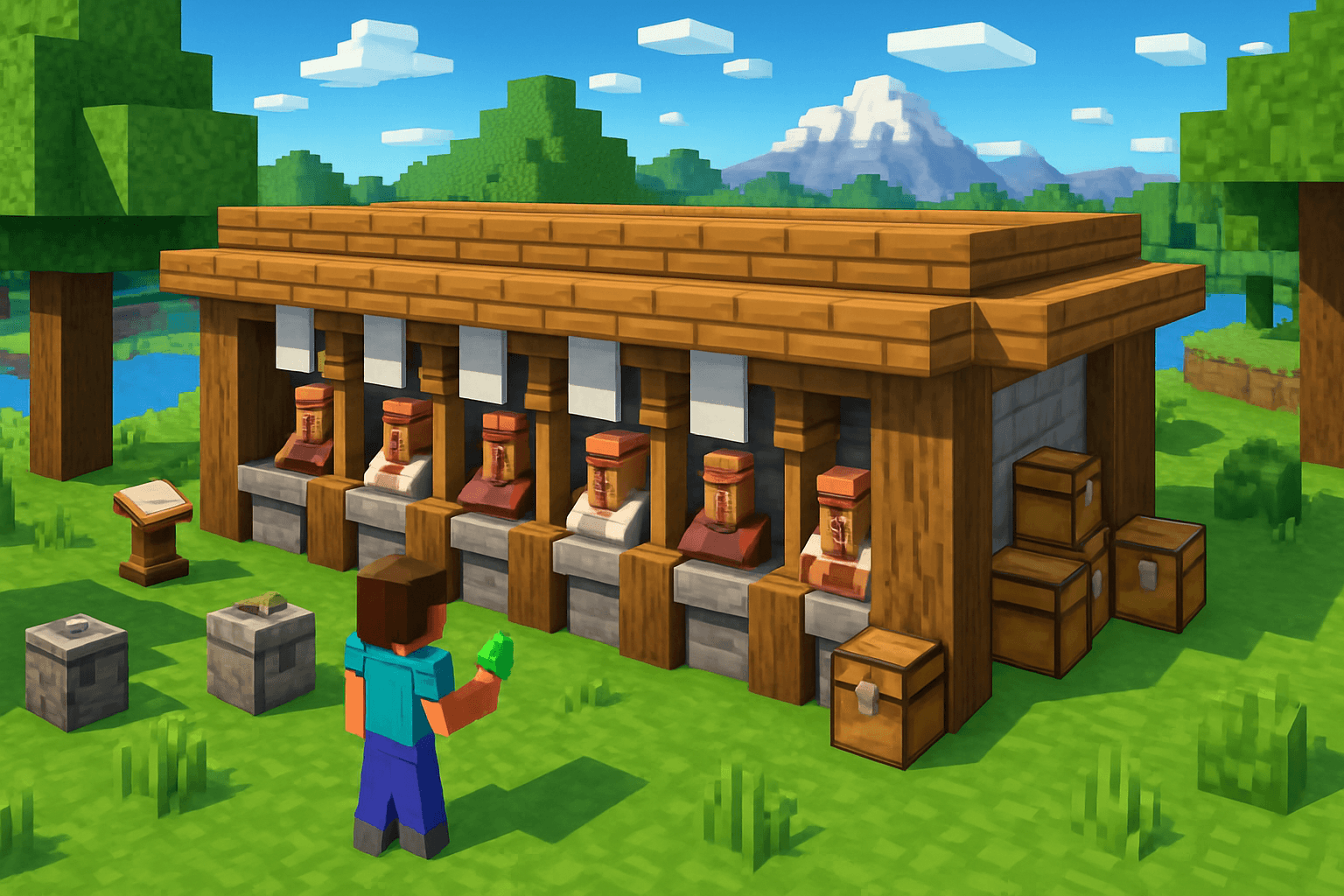

A villager trading hall is one of the most powerful systems you can build in survival Minecraft. Once you have one set up, you can access any enchantment book in the game on demand, generate unlimited emeralds, and obtain powerful gear at a fraction of the normal cost. This guide walks you through exactly how to build and populate your trading hall.
Why a Trading Hall?
Villager trading gives you direct access to specific items you would otherwise rely entirely on luck to obtain. Most importantly:
- Mending books — The single most valuable enchantment in the game. Without a librarian, you depend on random fishing or rare dungeon chests.
- Specific enchantment books — Fortune III, Efficiency V, Protection IV, Silk Touch — any enchantment you need, on demand.
- Unlimited emeralds — Farmer villagers buy crops for emeralds. One farmer with a large crop field generates hundreds of emeralds per day.
- Discounted diamond gear — Cured armorer and weaponsmith villagers sell fully enchanted diamond gear for very few emeralds.
Understanding Villager Professions
Each job block assigns a specific profession to a nearby unemployed villager. The most useful ones are:
- Librarian (Lectern) — Enchantment books
- Farmer (Composter) — Crops, bread, potions
- Armorer (Blast Furnace) — Armor, chainmail, shields
- Weaponsmith (Grindstone) — Swords, axes
- Toolsmith (Smithing Table) — Pickaxes, axes, shovels
- Cleric (Brewing Stand) — Ender pearls, potions, bottles
- Fletcher (Fletching Table) — Arrows, bows, crossbows
Setting Up the Hall
Location and Layout
Build your trading hall close to your main base. Villagers need to path back to their beds at night, so you want everything within the same compact area.
A standard cell layout works best. Each cell is 1 wide x 2 deep x 2 tall, with a solid back wall. Place one Bed in each cell. Place the Job Block in the cell or directly adjacent. Add glass so you can see the villager trades without entering the cell.
Getting Villagers
Use a Boat to transport villagers. Place a boat next to a villager, right-click to push them in, then push the boat to your trading hall. This is the most reliable method.
Alternatively, breed your own by placing two villagers in an enclosed area with beds and food (bread, carrots, potatoes). If there are more beds than villagers, they will breed.
Rolling for Specific Trades (Librarians)
Librarian trades are randomly assigned. To get the specific enchantment you want:
- Place a lectern next to an unemployed villager
- Check their first trade
- If it is not what you want, break the lectern (you get it back)
- Replace the lectern — the villager gets a new random trade
- Repeat until you get the enchantment you want
Important: Only do this before making any trades. Once you trade, the profession and trades are permanently locked.
Zombie Curing: The Most Important Trick
Cured zombie villagers offer dramatically reduced prices — often 90% discounts. A Mending book that normally costs 30 emeralds may cost 1 emerald after curing.
How to Cure a Zombie Villager
- Find a Zombie Villager
- Hit them with a Splash Potion of Weakness
- Right-click the zombie villager with a Golden Apple (8 Gold Nuggets + 1 Apple)
- They will begin shaking — wait 3-5 minutes
- They will fully cure and become a regular villager with massive discounts
Creating a Curing Station
Build a dark, enclosed chamber next to a cell. Lure your target villager in and let a zombie infect them (on Hard difficulty, infection always happens; on Normal, it is a 50% chance). Apply weakness potion and golden apple. Wait for the cure and move the cured villager back to their cell.
Protecting Your Trading Hall
Protect your hall with solid walls and a roof with no gaps, good lighting so no dark spots exist inside, iron golems placed in or around the hall, and cats near the entrance to scare away Creepers.
Common Mistakes to Avoid
- Trading before the villager has slept. A villager that has not yet slept in their assigned bed may not lock their profession properly. Wait for them to sleep at least once first.
- Not labeling your villagers. Use Name Tags to label each villager with their trade (e.g., "Mending," "Fortune III").
- Mixing beds. If villager A bed is near villager B job block, they may swap roles. Keep each cell clearly paired.
- Forgetting to restock. Villager trades replenish after they work at their job block twice per day.
- Ignoring zombie curing. Players who skip curing overpay by 10-30x for every purchase.
Pro Tips
- Build your trading hall near a Nether portal so you can quickly collect supplies and come back to trade
- A single Farmer villager with access to a large crop field generates enough emeralds to fund all your other trades
- Cleric villagers buy rotten flesh for emeralds — combine with a zombie farm for passive emerald generation
- Keep a spare Silk Touch pickaxe so you can relocate job blocks without destroying them
FAQ
Q: How many villagers do I need for a complete trading hall? A: At minimum: 3-4 librarians for different enchantments, 2 farmers for emerald generation, 1 armorer, 1 weaponsmith, 1 toolsmith, 1 cleric. That is 9-11 villagers for a well-rounded hall.
Q: Can I reroll a villager trade after I have already traded with them? A: No. Once you make a trade, their trades and profession are permanently locked. Roll before trading.
Q: Do the discounts from curing stack? A: The "Hero of the Village" effect gives temporary discounts with all villagers. Curing discounts are permanent and apply only to the cured villager.
Conclusion
A villager trading hall pays dividends for the entire lifespan of your survival world. Once you have Mending on all your gear and a farmer generating emeralds passively, you are essentially set for unlimited resources. Invest the time to build and cure your villagers properly and you will never scramble for enchantment books again.
Ready to go further? Check out the full Villager Trading Hall build tutorial for a step-by-step construction guide with materials list.