
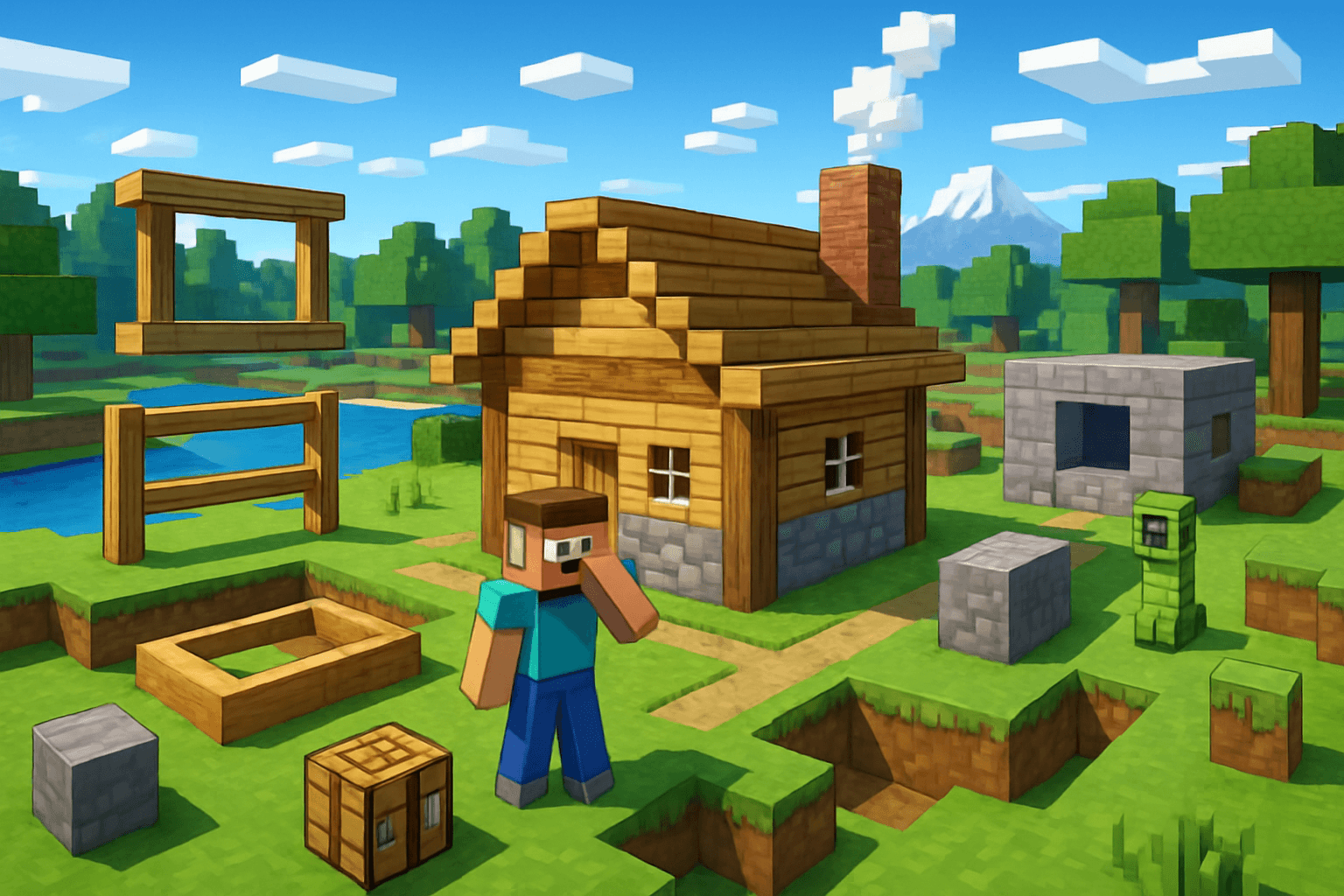

Most Minecraft starter houses are built for survival. Very few are built to actually last.
You know how it usually goes. A wooden box, chests scattered everywhere, a bed in the corner, and a few hours later you already want to tear everything down and start over.
The problem usually is not creativity. Most players simply build too fast without thinking about space, lighting, materials, or how the base will evolve later.
A good starter house does not need to be massive. It just needs to feel intentional.
Here are the biggest mistakes players make when building their first survival house and how to avoid them.
1. Building Something Way Too Big
This is probably the most common mistake in survival Minecraft.
You start imagining a huge cabin, a castle, or some cinematic base from YouTube. Then halfway through the project you realize you need endless wood, stacks of glass, more food, more tools, more lighting, and suddenly the build becomes exhausting instead of fun.
A starter house should solve your early game problems, not create new ones.
Smaller builds almost always work better in the beginning. Focus on shape, atmosphere, and details instead of pure size.
A compact house with depth and good proportions will always look better than a giant unfinished rectangle.
2. Ignoring the Terrain
A lot of players flatten an entire area before building because it feels easier.
Most of the time, that removes all the personality from the location.
Some of the best starter houses work naturally with the world around them. Hills, rivers, cliffs, forests, and uneven terrain already create atmosphere before you even place a single block.
Simple decisions make a huge difference:
- Building slightly above ground level
- Adding stairs to the entrance
- Placing the house near water
- Keeping natural trees around
- Using elevation instead of deleting it
The world should feel connected to the build instead of completely erased by it.
3. Making Every Wall Flat
Flat walls instantly make a build feel basic.
This happens because beginners often place blocks in straight lines without any variation or depth.
The good news is that this is one of the easiest problems to fix.
Adding even small details changes everything:
- Logs extending outward at the corners
- Stairs under windows
- Slabs around the roof
- Trapdoors as framing
- Small overhangs above entrances
Most good Minecraft builds are not actually complicated. They just use layering and depth well.
4. Leaving Lighting for the End
Lighting is not just functional. It completely changes the atmosphere of a build.
A house can look amazing during the day and terrible at night if lighting was treated as an afterthought.
Many starter houses end up either too dark or filled with random torches everywhere.
Instead, try to create softer and more controlled lighting.
Early game options like lanterns, campfires, candles, glow berries, and hidden torches already make a huge difference.
And do not forget the outside area. Paths, entrances, and surroundings matter just as much as the interior.
5. Using Too Many Random Materials
Another common mistake is mixing too many unrelated blocks together.
Oak walls, spruce roof, cobblestone floor, birch details, random colored glass. Everything starts fighting for attention.
The cleanest starter houses usually keep the palette simple.
A good rule is:
- Two main materials
- One accent material
- One contrasting texture
For example: spruce and stone, oak and cobblestone, dark oak and deepslate.
Simple palettes almost always feel more polished and intentional.
6. Treating the Interior Like Storage Only
A lot of players spend all their time on the exterior and then throw chests randomly inside.
That is usually what makes a build feel unfinished.
Interiors are what make a house feel alive.
Even small details help:
- Bookshelves
- Carpets
- Flower pots
- Ceiling beams
- Organized crafting areas
- Proper storage corners
Some of the coziest Minecraft houses are actually very small. They just feel lived in.
7. Rebuilding Everything Instead of Expanding
Many players abandon their starter base the moment they get better materials.
Usually that happens because the original build was never designed to grow.
The best starter houses are expandable from the beginning.
Instead of rebuilding everything later:
- Add a storage room
- Connect farms with paths
- Expand underground
- Create side buildings gradually
- Add a second floor later
Bases that evolve over time almost always feel more personal than giant mega builds finished all at once.
Final Thoughts
A good starter house is not about building something perfect.
It is about creating a place you actually enjoy returning to.
The best Minecraft worlds are rarely the biggest or most technical ones. They are the worlds that feel intentional, lived in, and slowly developed over time.
Start smaller. Use depth. Work with the terrain. Think about atmosphere early.
Most importantly, build something you will still want to improve later instead of replacing after one day.