
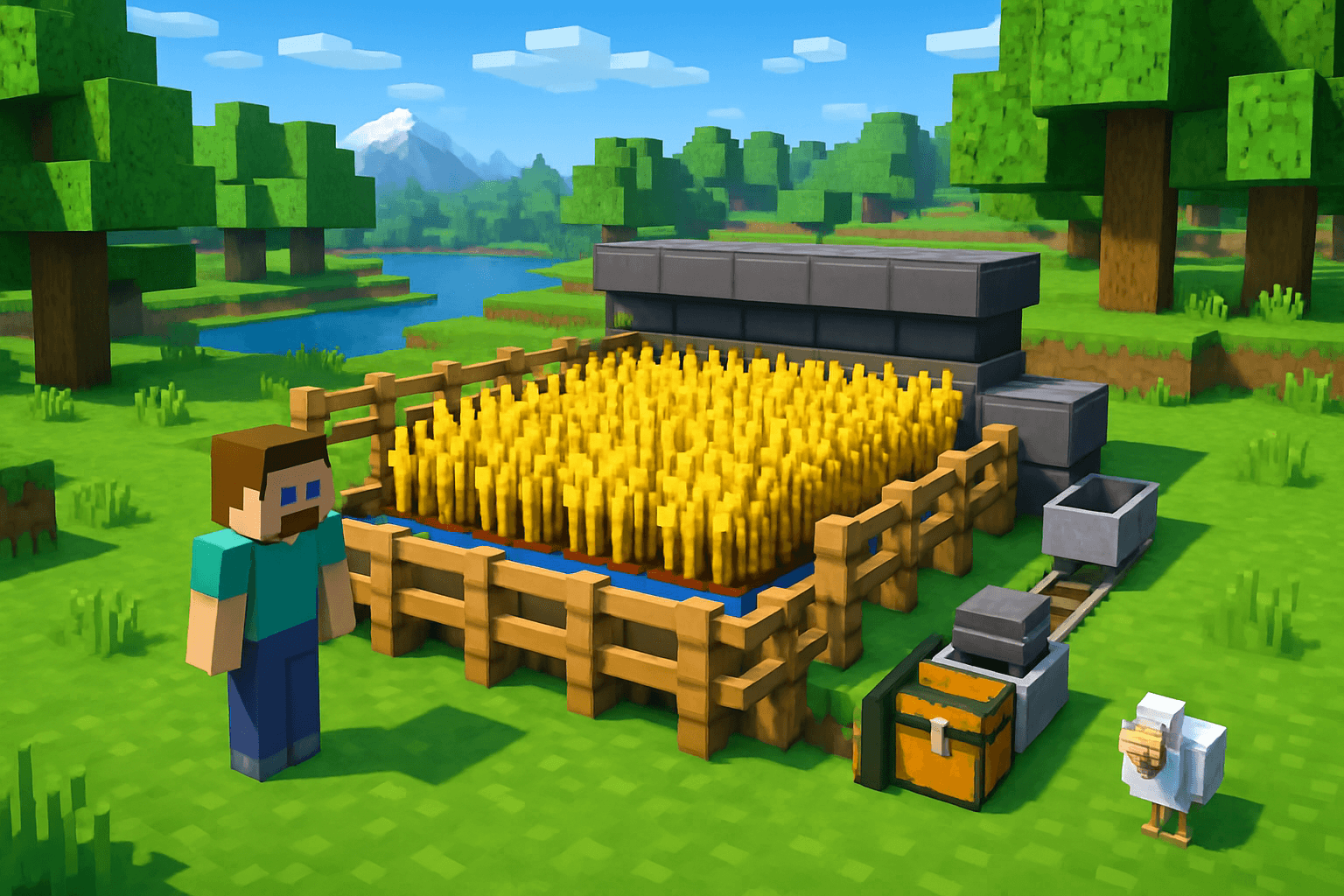

A villager farmer is the closest thing to a true "passive income" farm in survival Minecraft. Plant wheat, set up a villager, and walk away. The villager harvests and replants indefinitely while you build or explore elsewhere.
Unlike crop farms powered by redstone or pistons, there are no moving parts to break or lag sources to manage. It's purely economics—a farmer wants to work, so give them crops and they'll do it.
How Farmer Villagers Work
Farmer villagers automatically harvest mature wheat and replant the seeds. They follow simple logic:
- Walk around the farm area
- When they see a fully grown wheat block, harvest it
- Pick up the seeds
- Plant the seeds in nearby tilled farmland
The only issue: their inventory fills up. When it's full, they stop harvesting until you collect the drops. In practice, this means checking back every few hours of gameplay, or setting up hoppers to collect automatically.
The good news—this isn't complicated. One villager manages a large farm solo.
Materials Needed
Farmer Setup:
- 1 unemployed villager
- 1 composter (this assigns the farmer job)
- 1 bed (villagers need beds to stay in place)
Farm Area:
- Tilled farmland (hoe + dirt)
- Wheat seeds (break tall grass)
- Water source (1 water block hydrates up to 9x9)
Optional Automation:
- Hoppers and chests (automatic collection)
- Glass/slabs for walls and roof
Building the Farm
Step 1: Create Farmland
Dig out a 9x9 square. Place one water block in the center—this hydrates farmland up to 4 blocks away in every direction, covering the whole area.
Use a hoe on every dirt block around the water to convert it to farmland (dirt turns darker). Plant wheat seeds on every farmland block.
Step 2: Bring in the Farmer
Find an unemployed villager (plain brown robes, no badge). You can either build near an existing village or transport a villager using boats (push them into the boat from behind).
Place a composter within reach of the villager. They'll walk toward it and adopt the farmer profession.
Step 3: Bed Assignment
Place a bed nearby. Villagers need assigned beds to stay in one area. Without one, they wander endlessly, eventually leaving your farm.
At this point, the farmer starts working. They'll harvest mature wheat and replant seeds automatically.
Step 4: Automate Collection (Optional)
Dig one block below the center of the farm. Place a hopper, with a chest attached to it. Harvested wheat and seeds fall into the hopper and move into the chest.
For maximum efficiency, dig a trench under the entire farm and fill it with hoppers all pointing toward a central chest. This captures everything.
Step 5: Enclose and Protect
Walls and roofs aren't strictly necessary, but they solve problems:
- Walls prevent mobs from killing your farmer
- Roof prevents rain from destroying seeds
- Enclosure keeps the villager from wandering
Use glass if you want light penetration, or solid blocks if you prefer full control.
Scaling Options
Compact 5x5: One water block in center, 24 farmland blocks. Generates wheat at a slower rate but takes up minimal space.
Standard 9x9: 80 farmland blocks around one water source. Balanced—good production without wasting space.
Multi-Farm Setup: Build 3-4 farms, give each its own farmer. One farmer handles their assigned farm independently. Multiple farmers = more production but more effort to manage.
Maximizing Output
Use bone meal strategically: If you have bone meal, use it on wheat to instant-grow it. The farmer harvests and replants immediately, skipping the growth cycle. This creates a feedback loop—more wheat → more seeds → potentially faster growth with multiple uses.
Fortune III hoe: Mining wheat with Fortune III on your hoe gives 2-4 seeds per block instead of just 1. Better seeding for replanting. Mine your own wheat alongside letting the farmer work.
Feed the farmer: Farmers eat and breed if they have beds and food. If your farm's production is high enough, they'll breed and create baby farmers (who don't work until grown). Eventually you'll have multiple farmers if left long enough.
Uses for Wheat
Bread: Craft 3 wheat into 1 bread. It's a reliable food source with moderate saturation.
Animal breeding: Cows, sheep, llamas breed with wheat.
Farmer trading: Trade wheat directly to farmers for emeralds. A consistent emerald generator if you have surplus.
Composter: Wheat composts into bone meal, which speeds up crop growth everywhere.
Decoration: Wheat looks good in cottages and rustic builds.
Troubleshooting
Farmer won't harvest: Check their inventory isn't full. Also verify the wheat is fully grown (top turns brown/gold).
Farmer wanders away: They don't have an assigned bed. Place a bed closer.
Seeds disappearing: Rain and water are washing them away. Add a roof.
Production is slow: One farmer covers about 9x9 but takes time between cycles. More farmers = faster production. Or use bone meal to force-grow wheat for instant harvesting.