
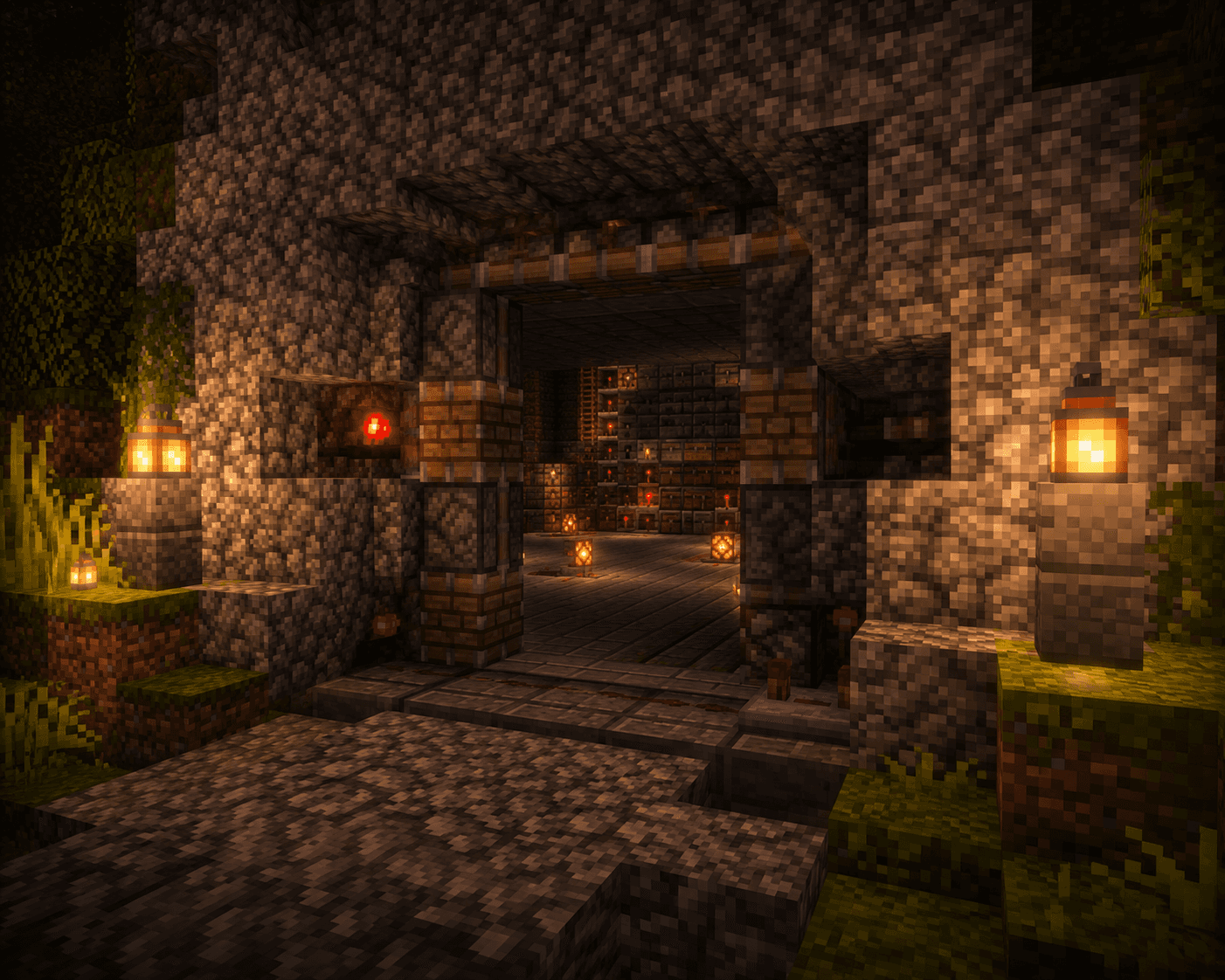

A hidden redstone door is one of the most satisfying builds in Minecraft. From the outside it looks like a solid wall. Press a hidden button or step on a pressure plate and the wall slides open, revealing a secret passage. It is practical security for your base and one of those builds that never stops being impressive.
This guide covers several designs from a simple 2x2 piston door to a seamless hidden entrance using paintings or bookshelves as disguise.
How Piston Doors Work
The core mechanic is straightforward. Sticky pistons push and pull blocks. When activated by a redstone signal, pistons extend and move blocks out of the way, creating an opening. When the signal stops, they retract and the blocks return, closing the door.
A hidden door extends this by concealing the redstone mechanism and disguising the door itself so it blends into the surrounding wall.
Design 1: Simple 2x2 Piston Door
The most reliable and beginner-friendly hidden door. Creates a 2-block-wide, 2-block-tall opening that blends into any wall.
Materials
- 4 Sticky Pistons
- Redstone Dust (around 20)
- 2 Redstone Torches
- 1 Button or Lever (hidden on the side)
- Building blocks to match your wall (around 20)
- 4 blocks for the door face (must match wall material)
Construction
The pistons:
- In your wall, mark a 2x2 opening
- Place 2 Sticky Pistons on the left side of the opening, facing right — one at floor level and one above it
- Place 2 Sticky Pistons on the right side, facing left — same heights
- Attach your wall material to the face of each piston — these are the blocks that will move to open and close
The redstone:
- Behind the left pistons, run Redstone Dust down and connect to a Redstone Torch below floor level
- Repeat for the right pistons
- Connect both sides to a single activation point — a button hidden on the wall beside the door or a pressure plate in front of it
Testing: Press the button — all four pistons should extend simultaneously, pulling the face blocks inward and creating the 2x2 opening. Press again — they retract and the wall closes.
Hiding the Button
Place the button on the side of a block adjacent to the door at a natural hand height. Paint it the same material as the wall if possible. Alternatively, use a Pressure Plate on the floor in front of the door — stepping on it opens the door automatically.
For better security, use a Tripwire Hook system: two tripwire hooks connected by string across a corridor trigger the door when you walk through, invisible and automatic.
Design 2: Painting Door
A painting door hides the entrance completely — from the outside, it looks like a decorative painting on a wall. Behind the painting is an open doorway.
How It Works
Paintings in Minecraft are entities that hang on walls. They do not have collision — you can walk through them. A doorway behind a painting is completely hidden to anyone who does not know it is there.
Construction
- Build your wall with a 1-block-wide, 2-block-tall opening (a standard doorway)
- On the block above the opening, hang a painting by right-clicking with a painting in hand
- The painting automatically sizes to cover the opening if the surrounding wall gives it enough space — aim for a 2x2 or larger painting to fully cover a standard doorway
- Walk through the painting to access the hidden room
No redstone required. This is the simplest hidden door in the game. The limitation is that anyone can walk through it accidentally — it provides concealment, not security.
Improving the Painting Door
Combine with a redstone door behind the painting: the painting hides the existence of the door, and the redstone door provides the actual barrier. You push through the painting and then activate the inner door with a hidden button inside the passage.
Design 3: Bookshelf Door
A bookshelf door uses a row of bookshelves as the door face, making it look like a library wall. It is the classic secret passage design and fits naturally into any interior.
Construction
- Build a wall of bookshelves — at least 3 wide and 2 tall for a convincing library look
- Behind the center section, install a 2x2 piston door using the Design 1 method
- Attach bookshelves to the piston faces instead of plain blocks — the bookshelves move with the pistons
- Hide the activation button behind a painting on the adjacent wall or under a carpet on the floor
Trigger using a Lectern: Place a Lectern with a book next to the bookshelf wall. Turning the page of the book sends a comparator signal — wire a Comparator from the Lectern to your piston door circuit. The door only opens when you interact with the book, which looks completely natural in a library setting.
Design 4: Seamless Floor Door
A floor door opens downward into a basement or underground area. From above it looks like part of the floor.
Construction
- Mark a 2x2 area in your floor
- Below the floor, place 4 Sticky Pistons facing upward
- Attach floor material blocks to the tops of the pistons
- When activated, the pistons retract downward, pulling the floor blocks down and opening the trapdoor
- A ladder or water column inside the shaft allows entry
Activation: Use a pressure plate offset to the side — stepping on it opens the floor. Or use a hidden lever disguised as a wall decoration.
Redstone Tips for Hidden Doors
Use Observers for automatic doors: An Observer facing outward detects when you approach and triggers the door. This creates a door that opens automatically when you walk up to it from the inside, without any button press.
Monostable circuit for auto-close: Connect a pulse extender to your door circuit to keep it open for a set time, then auto-close. Useful for pressure plate doors that should close after you pass through.
T-Flip Flop for toggle: If using a button that sends a brief pulse, add a T-Flip Flop circuit to convert the pulse into a toggle signal — one press opens, next press closes.
Conceal redstone with carpet: Redstone Dust on the floor is visible and gives away hidden doors. Run redstone under carpet where possible, or route it through walls and under floors.
FAQ
Q: Can other players find my hidden door? A: Determined players can find any hidden door by systematically pressing every button and stepping on every surface. The goal is concealment from casual observation, not absolute security. For maximum security, hide the activation method in a non-obvious location.
Q: Why are my pistons not moving in sync? A: Redstone signal timing is the usual cause. All pistons need to receive the signal at the same tick. Extend redstone runs with Repeaters set to the same delay on both sides of the door.
Q: Can I make a larger hidden door? A: Yes — 3x3 and larger piston doors exist but require more complex redstone to keep all pistons synchronized. The 2x2 design is the most reliable starting point. Larger designs are extensions of the same principle.
Q: What blocks work best for hiding a piston door? A: Use blocks that match your wall material exactly. Stone Bricks in a stone wall, Oak Planks in a wooden wall. The seam where pistons meet the surrounding wall is the only giveaway — minimize it by ensuring the piston face blocks are perfectly flush.
Conclusion
Hidden redstone doors are one of the most rewarding redstone projects in Minecraft — functional, impressive, and endlessly customizable. Start with the simple 2x2 piston door to understand the mechanics, then experiment with disguises and triggers until the door is truly invisible.
A good hidden door should make visitors walk past it without a second glance. When you achieve that, the build is complete.
For your next redstone project, check out our guide on Piston Basics and Contraptions for more mechanisms that build on the same principles.